
You searched for:
“abeyances”
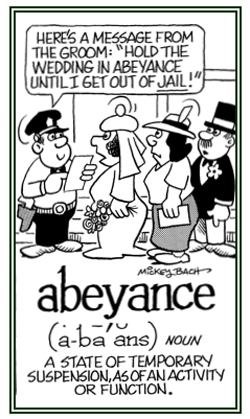
1. A situation which is being temporarily set aside; a suspension: Mark was told that the building project would be held in abeyance until spring.
2. A condition in which legal ownership of an estate has not been established: The uncertain abeyance of her father’s property caused a great deal of anxiety for Dorothy; so, the decision of the judge is expected to be important.
3. Etymology: in its beginning, abeyance meant "waiting with gaping (open) mouth". Something "held in abeyance" may cause some anxiety or impatience, but it hardly suggests "open-mouthed expectancy"; nevertheless, that was originally the literal meaning for the word.
© ALL rights are reserved.

© ALL rights are reserved.
Go to this Word A Day Revisited Index
2. A condition in which legal ownership of an estate has not been established: The uncertain abeyance of her father’s property caused a great deal of anxiety for Dorothy; so, the decision of the judge is expected to be important.
3. Etymology: in its beginning, abeyance meant "waiting with gaping (open) mouth". Something "held in abeyance" may cause some anxiety or impatience, but it hardly suggests "open-mouthed expectancy"; nevertheless, that was originally the literal meaning for the word.
Abeyance came from the Late Latin badare, "to gape". The word passed into the Old French spelling baer, beer, "to gape, to look with open mouth, to expect". From this was derived the old French abeance, literally, "a gaping at", but used metaphorically to express "expectation" or "longing".
This has resulted in the English abeyance, a legal term used about rights which were suspended, "held in abeyance", awaiting a proper claimant. Its meaning, however, has broadened in general use to indicate any kind of suspension or temporary suppression."
Go to this Word A Day Revisited Index
so you can see more of Mickey Bach's cartoons.
This entry is located in the following unit:
English Words in Action, Group A
(page 1)
An extensively bitter feud, contention, or quarrel that results in hostility or hatred. (2)