
English Words in Action, Group S
(a variety of English words which have developed through history and are currently used in our modern age)

Simply click on this banner (or the following link) and you will be on your way to stimulate your brain for greater word comprehension with quizzes based on some of the words in this unit.
"The seventh day is the sabbath or the day of rest and worship of the Lord thy God."
Except when directly quoting the Bible, in which Sabbath is spelled with a lower-case "s" (sabbath), it should be spelled with an upper-case "S" (Sabbath) in accordance with universal custom.
The Sabbath falls on Sunday among all christian sects, except the Seventh-Day Adventists when it falls on Saturday as also with Jews, and on Friday among Muslims.
2. Etymology: from Hebrew shabbath, "rest", the seventh day of the week, appointed in the Ten Commandments as a day of rest and worship to be observed by the Jews ("Remember the sabbath day, to keep it holy"), which is now Saturday; therefore, in subsequent Christian usage, the "Lord's Day", as observed by Christians is on Sunday.""The same Hebrew word has provided us with sabbatical, referring to the seventh year during which ancient Jews were required to refrain from tilling the soil (working on their farms) in order to "rest"; from which we get our modern term sabbatical, a year's vacation awarded to teachers in some educational institutions every seventh year."
Marla recently returned to work after a one-year sabbatical from her singing career.
2. A specifically designed bag typically with shoulder straps used for carrying heavy items; such as, camping or hiking gear: Each scout had a hiker's sack to carry while they were going for a walk.
Sacks were originally made of coarse cloth similar to those that were used in making "gunnysacks". The word sack came from Hebrew sag, "sack", "sackcloth".
In the Bible, "sackcloth and ashes" refers to the wearing of rough sackcloth garments and sprinkling ashes on the heads by those who are showing that they are sorry for sins or wrong doing that they have done.
3. Etymology: from sachet which is French for "little bag"; specifically, "a small ornamented bag" for carrying perfumed powder or something of a similar nature."2. To rob, to loot, or to pillage: The invaders sacked the village of anything of value.
The expression to sack, meaning "to loot", comes from the use of sacks by looters as a convenient means of carrying away their stolen goods.
2. A written or verbal report that is long and contains detailed narratives: Bob detailed the saga of his family problems.
A saga is a prose narrative that was written in Iceland between 1120 and 1400, dealing with the families that first settled in Iceland and their descendants, with the histories of the kings of Norway, and with the myths and legends of early Germanic gods and heroes.
3. A detailed narrative of events or personal experiences that have existed over a long time: Mike's sister is such a good storyteller that she can turn a simple walk to the grocery story into a saga.4. Etymology: from Old Norse saga, "a story" cognate with Old English sagu, "a saying".
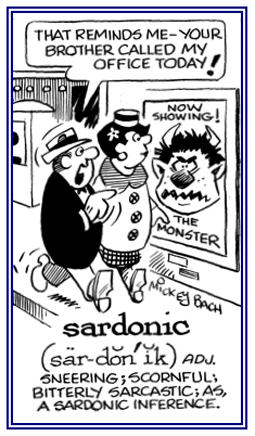
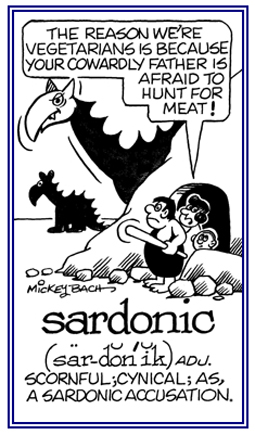
2. Etymology: from Greek: sardonios, "of bitter" or "scornful laughter".
Go to this Word A Day Revisited Index
so you can see more of Mickey Bach's cartoons.
Sam's special suit was of sartorial interest to those who were at the nightclub.
The couple arrived for their wedding ceremony in sartorial splendor.
2. Etymology: from Latin sartor, "tailor"; from sarcire, "to patch."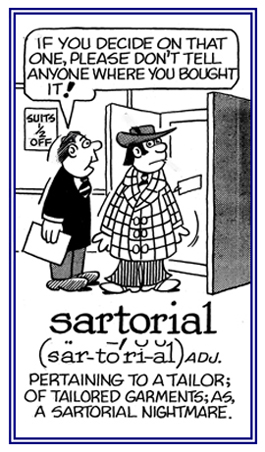
Go to this Word A Day Revisited Index
so you can see more of Mickey Bach's cartoons.
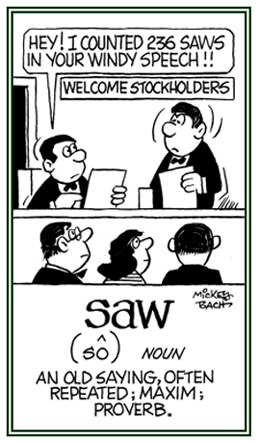
Frank's grandfather often recited the old saw about "An apple a day keeps the doctor away."
"Fools rush in where angels fear to tread" is another saw which means "look before you leap" because when a person does not plan ahead and think matters through, he or she could become involved in risky or unfavorable situations which a wise person avoids.
Here are the words to a famous song by Frank Sinatra and Elvis Presley about this saw:
Fools rush in, where angels fear to tread
And so I come to you my love
My heart above my head.
Though I see the danger there
If there's a chance for me
Then I don't care.
So open up your heart and let
This fool rush in.
Go to this Word A Day Revisited Index
so you can see more of Mickey Bach's cartoons.
- Absence makes the heart grow fonder.
- A bird in the hand is worth two in the bush.
- Actions speak louder than words.
- A journey of a thousand miles begins with a single step.
- A picture is worth a thousand words.
- Beggars can’t be choosers.
- Beauty is in the eye of the beholder.
- Better late than never.
- Birds of a feather flock together.
- Don’t bite the hand that feeds you.
- Don’t count your chickens before they hatch.
- Don’t judge a book by its cover.
- Don’t put all of your eggs in one basket.
- Don’t put off until tomorrow what you can do today.
- Easy come, easy go.
- Honesty is the best policy.
- Hope for the best, prepare for the worst.
- If it ain’t broke, don’t fix it.
- If you can’t beat ’em, join ’em.
- If you play with fire, you’ll get burned.
- If you want something done right, you have to do it yourself.
- No man is an island.
- People who live in glass houses should not throw stones.
- Practice makes perfect.
- The early bird gets the worm.
- The grass is always greener on the other side.
- There is no place like home.
- There is no time like the present.
- Two heads are better than one.
- Two wrongs don’t make a right.
- When the going gets tough, the tough get going.
- You can lead a horse to water, but you can’t make him drink it.
2. A situation in which a person has been deprived of something by means of deceit; such as, a confidence game or other fraudulent scheme; especially, for making a quick profit; a swindle: Every day people read in the papers about those who have fallen prey to criminal scams because someone was trying to deceive them in order to get their money.
3. Etymology: from 1963, used as a noun or a verb; U.S. slang; said to be a carnival term, of unknown origin; however, it is obviously related to "fraud" in meaning.
2. Etymology: a neologism that blends scam + campaign and apparently came from advertising businesses in order to fake advertising campaigns for nonexistent products that were submitted to "ad-of-the-year awards" and which can now be applied to political campaigns and other activities.
2. Etymology: a term that blends scam + campaign which has been coined to form a new word.
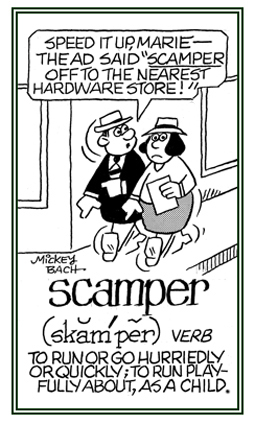
Mark was shocked to see a mouse scamper across his living room while he was watching TV.
Go to this Word A Day Revisited Index
so you can see more of Mickey Bach's cartoons.
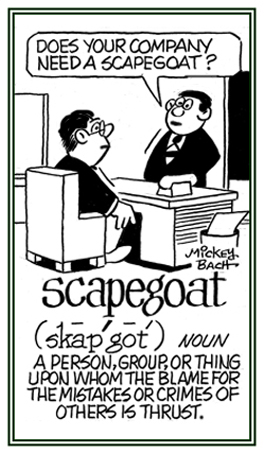
2. Etymology: from Hebrew azazél, iterally the "goat that escapes."
Go to this Word A Day Revisited Index
so you can see more of Mickey Bach's cartoons.
Links to all of the groups of English words in action, Groups A to Z.
You may see the bibliographic list of sources of information for these words in action.
